An exceptionally strong solar storm reached Earth last night, creating a colorful spectacle visible far into southern Europe. Webcam images from the Alps overnight were impressive. In this forecast I first look back at the PA#4 snowfall and search for explanations as to why totals ended up a bit lower than expected and hoped for. I also discuss the outlook toward the end of the week, with several snow phases on the table.

Looking back at PA#4
Chris already touched on it yesterday, but today I’ll also take a moment to look back at PA#4, which ultimately disappointed a bit in the details. On a larger scale, a decent snow layer did fall and there was certainly plenty of fun to be had, but regionally it didn’t quite turn out as expected. One of the reasons was that temperatures remained relatively mild, causing the snow to be fairly heavy up to higher elevations. The live feedback from the mountains is extremely valuable to us in this respect. It keeps us sharp and helps us improve these kinds of verifications.
A key issue was the position of the low-pressure system, which was located very far south, almost near the Tunisian coast. Although the modeled position from last week matched the actual position on Sunday and Monday reasonably well, it did mean that moist air struggled to reach northern Italy. As a result, areas in Piemonte ended up more on the edge of the system, rather than benefiting from a small-scale Genoa low that would normally provide a more direct and nearby moisture supply. In most model runs, the picture was somewhat more optimistic, despite an already noticeable degree of uncertainty, but overall snowfall coverage turned out to be clearly less. In addition, upper-level flow was rather weak, meaning there was simply not enough dynamic support for sustained snowfall over Piemonte and surrounding regions.
I also discussed this case briefly with an Italian meteo-colleague. Besides the factors mentioned above, he attributes the outcome to the difficulty models had in correctly resolving the large-scale interaction between the Atlantic high-pressure ridge and the low-pressure system. This was essentially a borderline situation between an extratropical depression still coupled to the jet stream and a cut-off low. In that transition zone, the models faced a big question mark, because a small increase in cold air from the north could have completely changed the setup for northern Italy. That’s why we were already somewhat cautious earlier last week, even though it still looked like it could become a solid episode. Unfortunately, things didn’t fully fall into place this time, despite the fact that many regions still saw genuinely PA-worthy snowfall.
A second chance?
With some caution, I’d say a second chance looks possible toward the end of the week. In the coming days, the pressure gradient over the Alps weakens, and with it the wind. Under the influence of high pressure, conditions will be mostly sunny in many areas, with increased cloud cover limited mainly to the southwestern Alps due to the depression over the Mediterranean.
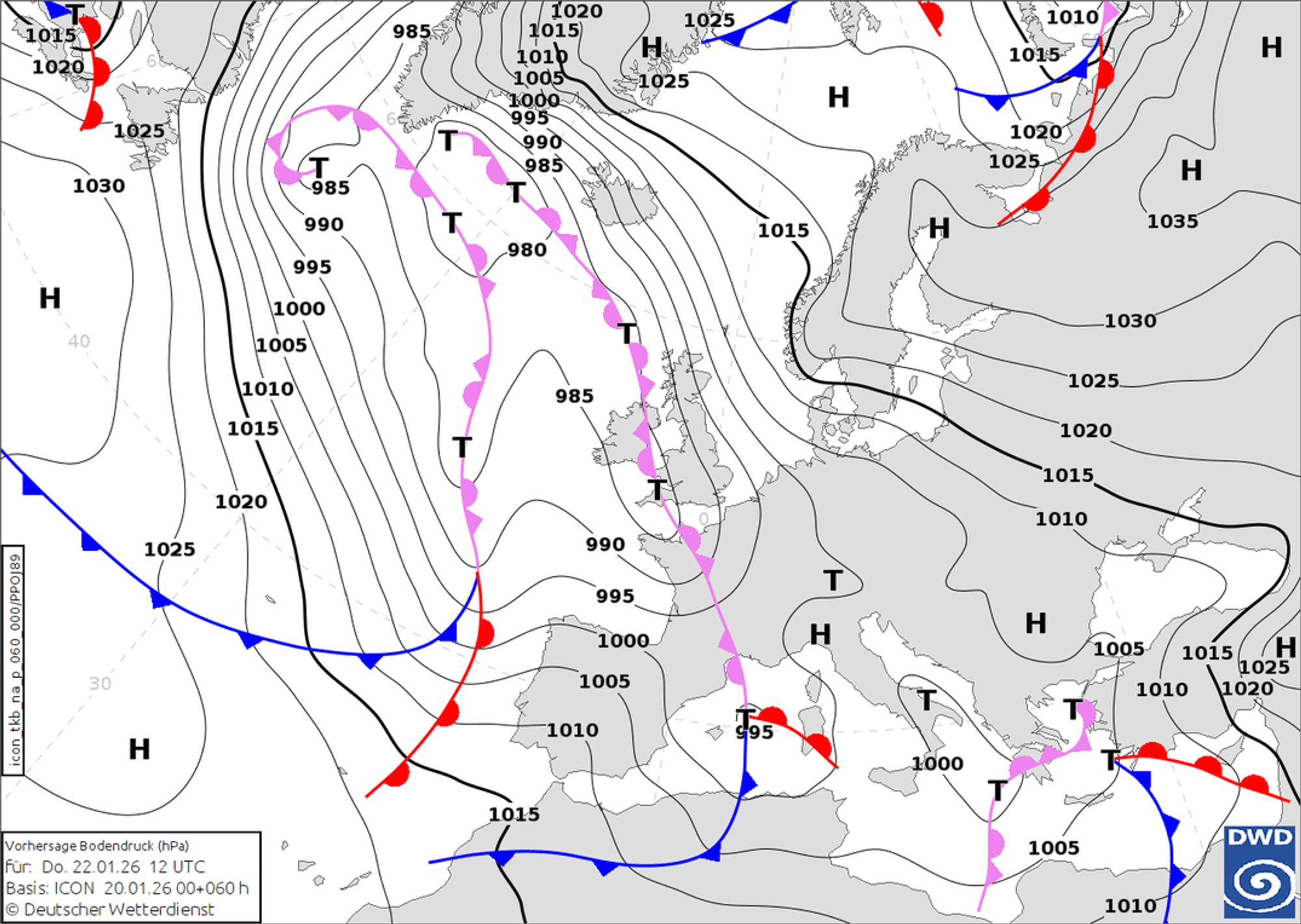
On Thursday, new snow arrives in the western Alps. The front weakens as it moves in later in the day. By Friday morning, around 5 to a maximum of 15 cm is expected from the Aravis range down to the Maritime Alps. In the northern French Alps, amounts decrease quickly further inland, meaning large parts of Savoie and Haute-Savoie will see little impact. The snow line starts around 1300-1500 meters and drops several hundred meters overnight into Friday.
Toward the weekend, two additional snow phases are possible for the western and southern Alps. The driving force behind this setup is a stronger depression over the Bay of Biscay, which, with colder air wrapping around its western flank, also allows a secondary low to deepen over the Mediterranean. Concretely, this means that both the western Alps (especially southern France) and later the Italian southern Alps could receive a solid fresh snow layer. On Friday, the snow line may briefly rise to just above 1500 meters before dropping again later. For large parts of these regions (note: not the northern Alps), totals of roughly 20-50 cm are possible, with local amounts potentially higher.
As always this early, there’s a catch. GFS, for example, clearly shows lower snowfall totals for the Italian Alps compared to the European model. At the same time, some ensemble members still indicate significant uncertainty. ECMWF places the Biscay low slightly closer to the Alps, while GFS keeps it at more distance. ECMWF also develops the Mediterranean secondary low more convincingly over the weekend, resulting in more snowfall for the southern Alps, whereas recent GFS runs remain more cautious, failing to fully establish the core of the low over the Mediterranean.
Jet stream gaining strength
Finally, a quick look higher up. The jet stream is ramping up significantly. According to current projections, it is likely to take a relatively southern track toward the end of the week and into next week, favoring colder air and renewed snow chances for the Alps. First around the weekend, but potentially also beyond into next week. How exactly this evolves in the models over the coming days remains to be seen, but a strong jet stream acts as a launchpad for Atlantic depressions, which may also deepen rapidly, as we already see with Friday’s system. Which parts of the Alps will benefit most next week is still impossible to say at this stage, as storm tracks and low-pressure development remain key uncertainties.
Reacties
Seems like an active season, does the pattern La Niña play into this?? Would love to hear any correlation with that benefiting snowfall in the alps…
For my part, I try to find any relationship between El Niño, el Nina and forecast or snowfalls in Europe .
As much as I readied , I didn’t find that explanations or links .
May be the effect , only on jet stream… it occurs in pacific. If you find something related, may be interested